

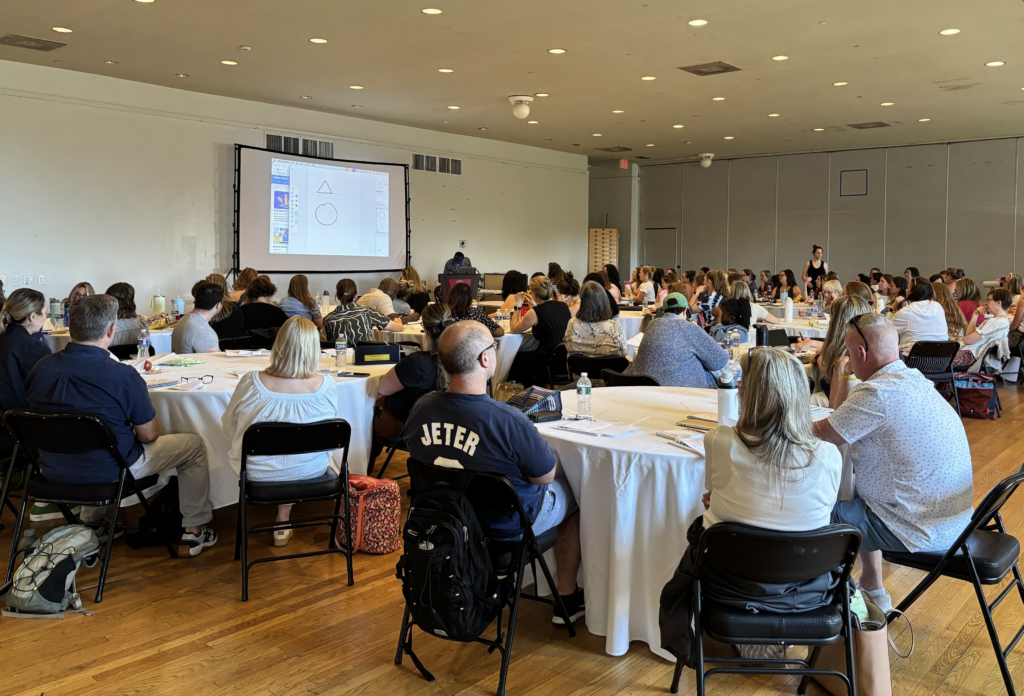
On July 20 and July 21, more than 200 educators gathered at Manhattanville University for the 2026 Fresh Thinking Conference, a collaborative professional learning event designed to strengthen K–5 mathematics instruction through practical strategies, classroom resources, and sustained year-round support. Hosted by the Fresh Thinking Foundation, the Rockland Teachers’ Center Institute, and Manhattanville University’s School of Education, the conference focused on helping educators build stronger student outcomes through conceptual understanding, number sense, and visual learning models.
Unlike traditional one-time professional development experiences, the Fresh Thinking Conference provides participants with a year-long partnership aimed at ensuring new learning translates into meaningful classroom practice. Teachers left the conference with classroom-ready instructional strategies, digital and print resources, and access to ongoing professional learning designed to support implementation long after the conference concluded. The conference featured speakers Greg Tang Sr. (author of the Tang Math K-5 curriculum and President of the Fresh Thinking Foundation), Dr. Margaret Keane (Professor Emerita in the Health Sciences and former Chair of the Psychology at Wellesley College and Associate Director of the Memory Disorders Research Center at Boston University School of Medicine and V.A. Boston Healthcare System), Greg Tang Jr. (Founding Partner of TangMath.com and an expert in education technology), and Tammy Tang (author of a dozen best-selling technology resource books and Director of the Fresh Thinking Foundation).
“Math education is important to us, and we want to provide professional development opportunities to mathematics educators,” said Brian Carolan, Dean of the School of Education at Manhattanville University. He added, “The opportunity for Manhattanville to host the conference on campus came from our longstanding partnership with the Rockland Teachers’ Center Institute.”
Throughout the two-day Fresh Thinking Conference, participants explored research-based instructional practices that emphasized reasoning, problem-solving, and deep conceptual understanding. Conference sessions highlighted the use of visual and abstract models to strengthen mathematical thinking and equip teachers with strategies that support diverse learners.
During the upcoming academic year, those who participated in the conference will also have access to free virtual professional development sessions, lesson-planning assistance, ongoing instructional coaching, and a library of live and recorded student lessons to help sustain and refine implementation in their classrooms. This follow-through model is designed to help educators continuously strengthen their practice, rather than relying on a single workshop experience. By supporting teachers over time, the conference aims to increase instructional confidence, improve consistency in mathematics teaching, and create lasting benefits for students across participating schools and districts.
For district and school leaders, the conference represents an investment in instructional capacity-building that extends beyond individual classrooms. By providing teachers with high-quality resources, ongoing coaching, and opportunities for continued learning, the Fresh Thinking Conference aims to create scalable, sustainable improvements in mathematics instruction and student achievement.